The iPhone Finally Has a Real Aperture—Does That Change Photography?
The iPhone has always had a real aperture.
Light has to pass through an opening before it reaches the camera sensor, whether the camera is built into a phone or attached to a collection of expensive lenses. What the iPhone hasn’t previously offered is an aperture that the photographer can physically change. That distinction matters.
Apple’s newly announced iPhone 18 Pro uses a variable aperture on its 48-megapixel Fusion Main camera. Instead of operating through one fixed opening, the camera provides four settings: f/1.48, f/1.8, f/2.8 and f/4. Apple says the aperture can adjust automatically according to light and depth of field, or be selected through the Camera app’s new Pro controls. The phone is available from September 18, with pre-orders beginning September 12. Those specifications and dates come directly from Apple’s iPhone 18 Pro information.
This is more than another software portrait effect. The aperture alters the light before it reaches the sensor. It is also not about to make a phone camera behave exactly like a full-frame camera with an f/1.4 portrait lens. Both statements can be true. An aperture performs several jobs at once. A wider opening allows more light to reach the sensor. A narrower opening allows less light. Changing the aperture also affects depth of field, the range of distances that appear acceptably sharp, and can alter how bright points of light are rendered. On the iPhone 18 Pro, f/1.48 is the widest available setting. It gathers more light than f/2.8 or f/4, which can help the camera work with shorter exposure times or lower sensitivity in dim conditions.
That matters because low-light phone photography often depends on combining several exposures. The phone captures information across a brief sequence, aligns it and processes the result into one photograph. The method can produce an impressive image, but movement during the sequence remains difficult. A person may turn their head. A child may move a hand. Leaves may shift in the wind. The software can correct some differences, although it cannot always restore a moment that was never recorded sharply. A wider physical aperture gives the camera more light to work with at the instant of exposure. Apple claims the new system provides around 50 per cent better low-light performance at f/1.48, although that is the manufacturer’s comparison and should be treated as such until independent testing becomes available.
The principle is sound even without accepting every promotional number. More light can reduce the burden placed on long exposures and aggressive processing. A variable aperture becomes equally interesting in bright conditions. Phone cameras usually control exposure through shutter speed and electronic processing because their apertures are fixed. In strong daylight, the shutter may become extremely fast. That is rarely a problem for an ordinary still photograph, but it affects movement in video and removes a creative choice from the photographer. Closing the aperture reduces the incoming light. That can provide more freedom to select a shutter speed for the way movement should appear rather than simply accepting the speed required to prevent overexposure.
It does not replace a neutral-density filter when a dramatically slow shutter is wanted in full sun. Moving from f/1.48 to f/4 reduces light substantially, but not enough to turn a bright midday exposure into several seconds of blurred water. It does give the camera another physical control.
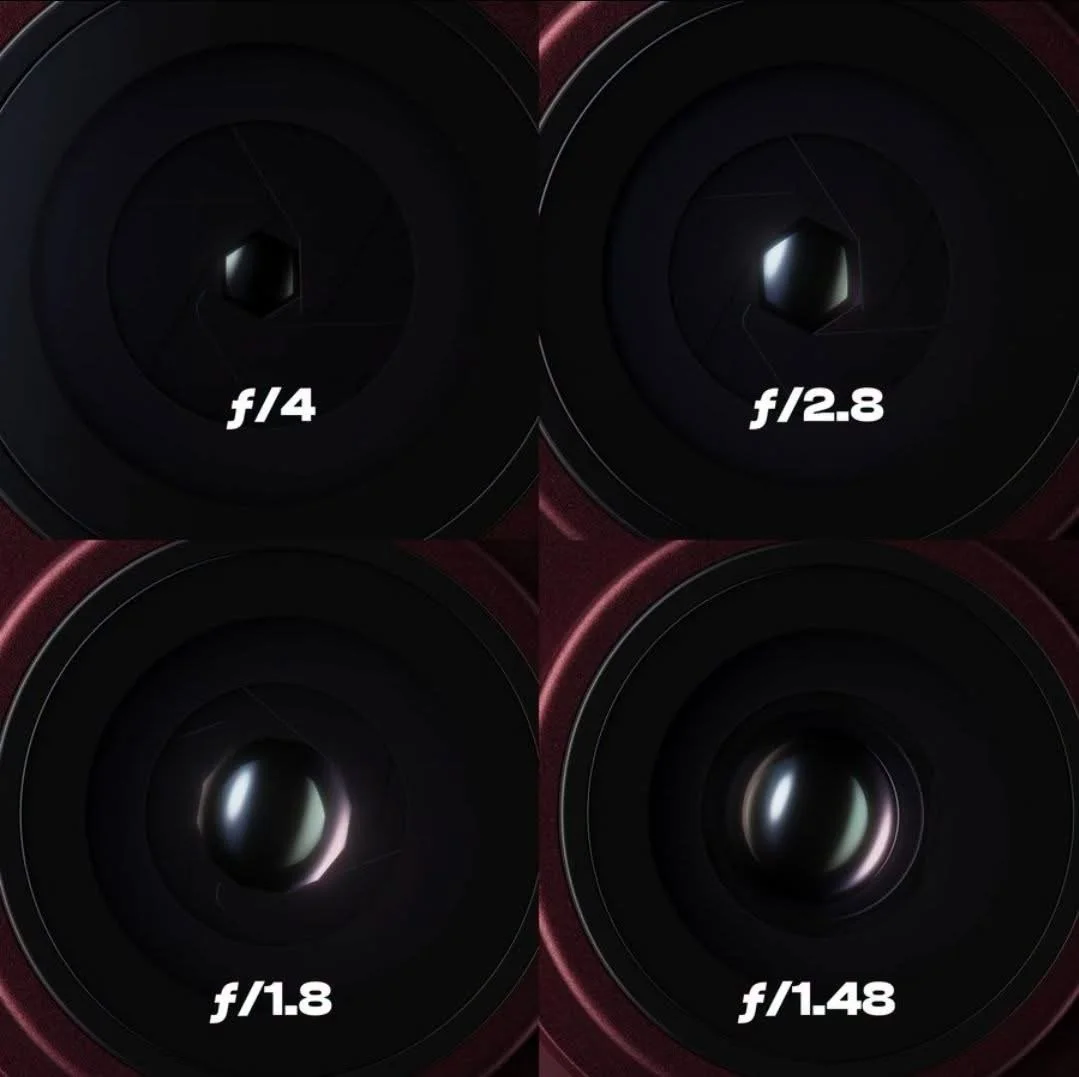
Image from Tech Overwatch
Depth of field will attract most of the attention because it is the effect photographers immediately associate with aperture. Apple describes f/2.8 as offering more depth and f/4 as providing maximum depth. At f/4, more of a scene can appear sharp from front to back. That can be useful when photographing a group arranged at different distances, a close object with important surroundings or a landscape containing several visual layers. Opening to f/1.48 reduces depth of field and can separate a close subject from the background optically.
The important word is “reduces.” A phone’s main camera still uses a relatively short actual focal length and a sensor much smaller than full frame. At the same framing and subject distance, those characteristics naturally produce greater depth of field than a larger camera with a longer lens. The f-number alone does not determine the appearance. An f/1.48 aperture on a phone should not be expected to create the same shallow focus as f/1.4 on an 85mm full-frame lens. A close subject with a distant background may show genuine optical separation, but an ordinary head-and-shoulders portrait can still retain considerable background detail. That is where computational portrait modes continue to operate.
Computational blur begins with an image containing relatively broad physical focus. The phone estimates depth, identifies the subject and applies simulated blur to areas it believes should sit outside the focal plane. Good processing can look convincing, particularly around simple outlines. Complex boundaries reveal the difference. Loose hair, glasses, translucent fabric and gaps between fingers can confuse a depth map. The transition from sharp to blurred areas may not behave like the gradual optical transition produced by a lens. A physical variable aperture does not have to identify the edge of someone’s hair. It changes how the lens forms the image. Software can still build on that optical result. The iPhone will not suddenly abandon multi-frame processing, subject recognition or computational portrait effects because it has gained aperture blades. The more likely development is a closer partnership between optics and computation. That is potentially more valuable than choosing sides between “real” and “fake” blur.
The physical aperture can provide a stronger starting image. Processing can then handle dynamic range, colour, noise and effects that cannot be achieved through the small lens alone. Apple also says f/4 can create starbursts around bright lights. That effect occurs when light diffracts around the edges of aperture blades, producing rays whose appearance depends partly on the iris design. It is a small creative detail, but an interesting one. Phone photographs made at night have often rendered point lights as small bright shapes, flare or processed highlights. A controllable iris introduces another way to interpret those lights before software becomes involved.
There is a compromise at narrow apertures. Diffraction increases as the opening becomes smaller. On a high-resolution, physically small sensor, that can soften fine detail. The camera may therefore prefer wider settings in some situations even when greater depth of field sounds desirable. This is why automatic aperture selection could be useful. The phone can balance available light, depth and optical performance without requiring every user to understand the calculation. Manual control still matters because the camera cannot know the photographer’s intention. If I want a nearby object separated from a complicated background, I may choose the widest opening even when there is abundant light. If several people occupy different distances, I may accept a higher ISO or slower shutter in exchange for the additional depth offered by f/4. Those are photographic decisions rather than technical corrections.

The wide aperture lets the iPhone capture more light and more detail after dark now. Photo Credit: Apple
The new Pro controls extend that idea. Apple says aperture, shutter speed, white balance and a histogram can be brought into the standard Camera app. This makes the phone more useful as a learning tool because cause and effect can be observed directly. Change the aperture and watch the exposure respond. Adjust the shutter speed and decide whether movement should be sharp or blurred. Inspect the histogram instead of relying entirely on screen brightness. The controls do not automatically make a photograph thoughtful. They simply allow the photographer to take responsibility for more of it. Most owners will probably leave the aperture on automatic most of the time. That is not a failure. Automatic exposure exists because it works quickly, and speed is one of the phone camera’s greatest advantages. The variable aperture becomes valuable when the automatic decision conflicts with the photograph someone wants to make.
Does this remove the need for a dedicated camera?
No, although it makes the boundary more interesting.
A larger camera still offers interchangeable lenses, larger sensors, more substantial controls, stronger flash integration and greater flexibility at long focal lengths. Its shallow depth of field comes from physical scale, not only the number printed beside the letter f. The iPhone offers something different. It is already in a pocket, ready within seconds and connected to an editing and sharing workflow. Its computational tools can solve exposure problems that would require more deliberate work with a conventional camera. Variable aperture strengthens that smaller system. It does not turn it into a larger one. I also don’t think the feature finally makes the iPhone a “real camera.” It was already a camera. Serious photographs have never depended on whether the lens can be removed.
What changes is the relationship between convenience and control. Phone photographers can now make an optical decision that was previously fixed by the manufacturer. The phone can decide how much light passes through the lens, or the photographer can intervene.
If you’d like practical help understanding how aperture, shutter speed and depth of field shape a photograph on either a phone or dedicated camera, you can explore my private photography lessons in Brisbane.
The more interesting question is not whether variable aperture makes the iPhone professional.
It is whether people will use it deliberately.
Would you select f/1.48 for a close portrait, close to f/4 for a layered street scene, or leave the phone to make the decision? A new control only changes photography when someone understands why they might reach for it.