Better Wildlife Photography Begins Before You Raise the Camera
The camera may record the moment, but patience, observation and thoughtful positioning are usually what make that moment possible.
Wildlife photography is often presented as an equipment problem. You need a longer lens, faster autofocus, more frames per second and enough megapixels to crop away everything that didn’t go according to plan. Equipment certainly matters. Photographing a small bird at a distance is easier with a telephoto lens than it is with a standard zoom. A responsive camera gives you a better chance when a quiet scene suddenly becomes action. However, equipment can only record what happens in front of it. It can’t tell you where to stand, when to wait or what an animal is likely to do next. Most of the bird photography I do now takes place around Brisbane, particularly near the bay and its surrounding parks. Before moving to Australia, I also photographed birds in North Carolina. The species and environments may be different, but the basic lesson has remained the same: better wildlife photographs usually begin well before I raise the camera. They begin when I stop treating the bird as an object to collect and start paying attention to what it is doing.
When I arrive somewhere with birds, the temptation is to begin shooting immediately. There is a fear that the subject will fly away before I have anything on the memory card. Taking a quick record frame isn’t necessarily a bad idea, but the first photograph rarely needs to become the final photograph. Watching for a few minutes can tell me far more than firing a burst as soon as I arrive. A bird may repeatedly return to the same perch. It may follow a particular route through shallow water, pause before taking flight or become more active whenever another bird enters its space. These small patterns give me clues about what could happen next. Once I recognise them, I’m no longer relying entirely on reaction. This is one of the great differences between simply seeing a bird and beginning to understand its behaviour. A static portrait can show us what the bird looks like. A photograph of feeding, calling, bathing, defending territory or interacting with another bird begins to reveal something about its life. That doesn’t require expert-level knowledge of every species. Curiosity is enough to begin. Watch which direction the bird is moving. Notice what catches its attention. Look at how it changes posture before it flies. The longer you observe, the less random the encounter becomes.
One of my favourite examples happened during a visit to the bay. I had my LUMIX S5II and Sigma 100–400mm with me, but I wasn’t moving around trying to force something interesting into the frame. I sat down with my lunch, kept the camera nearby and allowed the birds to continue doing what they were already doing. After a while, my presence was no longer the most interesting thing in their environment. A gull began working through the shallow surf. It caught a small fish and started tossing it into the air, catching it and adjusting its grip before finally swallowing it. The entire sequence unfolded in front of me because I was already sitting there, watching and ready. The camera and lens helped me capture the action, but they didn’t create it. The important decision had been made earlier: I stayed. Had I been walking directly towards every bird I saw, the gull may have moved away or behaved differently. Had I packed the camera as soon as I stopped for lunch, I would have watched the moment without being able to photograph it. Patience placed me in the scene without demanding anything from it. That photograph means more to me than a simple gull portrait because it contains behaviour. It records a small event that lasted only a few seconds, but those seconds were made accessible by the quiet time that came before them.
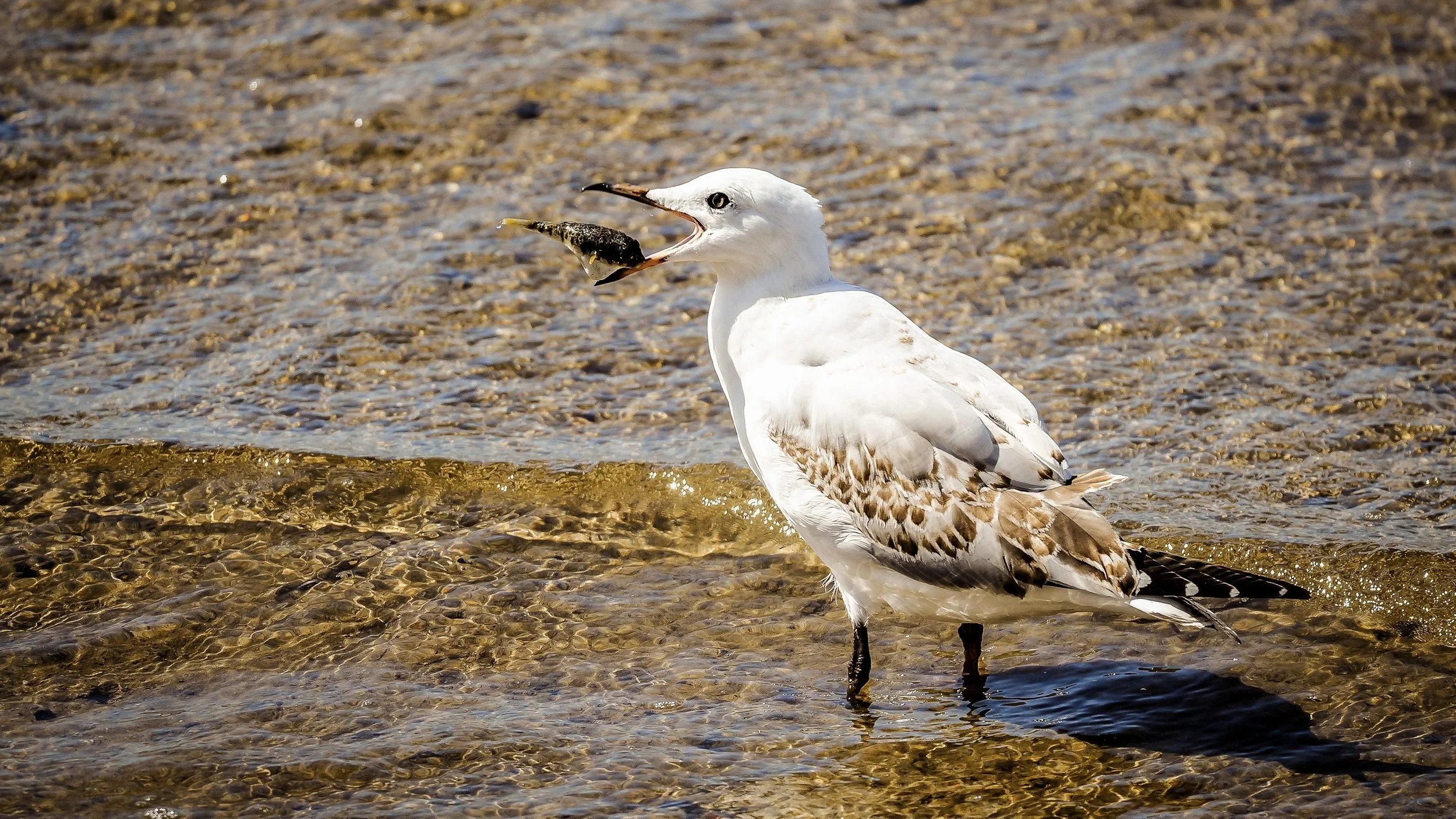
A powerful wildlife photograph isn’t only about the animal. The background, light, shooting angle and surrounding environment all influence how clearly the subject communicates. This is why positioning matters before the action begins. If I stand above a bird and point the camera towards the ground, the background may become a busy mixture of grass, rocks or reflective water. Moving lower can place a more distant background behind the subject, creating cleaner separation without changing lenses. Shifting a few steps sideways may remove a bright distraction or place softer light across the bird’s feathers. White birds are particularly unforgiving in harsh sunlight. A camera can preserve an impressive amount of detail, but strong midday light may still create bright feathers, deep shadows and distracting reflections. Looking at the direction of the light before concentrating on the bird gives me a better chance of producing a balanced frame. I also try to consider where the bird is likely to move. If it appears to be travelling from left to right, I can compose with more space in that direction. If several birds are using the same patch of shallow water, I can choose a position that gives me a clean view without repeatedly following them. None of this guarantees a photograph. Wildlife doesn’t follow a shot list. It simply improves the conditions under which a photograph might happen.
My S5II and Sigma 100–400mm are useful because the combination gives me reach, stabilisation and enough flexibility to respond when a bird changes its distance. However, owning that combination doesn’t automatically produce a meaningful wildlife photograph. Preparation matters more than constantly changing settings once the action starts. Before settling into a location, I want a shutter speed appropriate for the subject, an autofocus mode capable of following movement and an exposure that protects important detail. The exact settings depend on the light and the bird. A bird standing calmly allows more freedom than one flying quickly across the water. The purpose of preparing the camera isn’t to discover one perfect collection of settings. It is to remove unnecessary decisions from the moment itself. When something happens, I want my attention on the bird rather than buried in a menu. This is also why checking the basics matters. Is the battery charged? Is there space on the card? Is the lens clean? Is the camera still configured for something completely different from the previous shoot? These are ordinary questions, but wildlife photography frequently turns on ordinary preparation. A rare moment doesn’t wait while I search for the right autofocus setting.
Waiting is often described as if it means doing nothing. In wildlife photography, good waiting is active. I’m looking at changes in light, watching the background and noticing whether the birds are becoming more comfortable or more alert. I may take a few frames to check the exposure or examine how the background appears through the lens. I may decide that my original position isn’t working and move slowly while the scene is still quiet. What I don’t want to do is fill every second with shutter clicks. Constantly photographing the same stationary pose can create hundreds of nearly identical files without deepening my understanding of the scene. Lowering the camera occasionally allows me to see more than the narrow view through the telephoto lens. It helps me notice another bird approaching, a change in behaviour or an interaction developing just outside the frame. Some outings will still produce very little. That isn’t necessarily failure. Time spent learning a location can make the next visit more productive. I may discover where birds feed as the tide changes, which areas receive the best morning light or where I can sit without disrupting their movement. The location becomes familiar, and familiarity gives me a better chance of recognising when something unusual is about to happen.
Check out my latest Youtube Video
Patience and ethical wildlife photography are closely connected. If I chase a bird until it flies, block its path or move so close that it stops feeding, I haven’t captured natural behaviour. I have changed it. A longer lens should help create distance, not justify ignoring it. Warning signs vary between species, but sudden alertness, repeated movement away, interrupted feeding or a fixed awareness of the photographer can indicate that the bird is uncomfortable. At that point, backing away is more important than getting a tighter composition. This is especially important around nests, chicks and feeding areas. A photograph is never worth placing unnecessary pressure on an animal. Letting the bird control the encounter generally produces more authentic photographs anyway. When wildlife resumes its ordinary behaviour, the resulting images have a sense of life that forced encounters rarely possess. Learning to recognise these boundaries is part of becoming a better photographer. Technical skill determines whether the image is sharp and properly exposed. Judgement determines whether the image should have been made in the first place.
The most useful change I have made in bird photography isn’t a new autofocus mode or a longer lens. It is learning to give a scene time. Observing first helps me anticipate behaviour. Choosing a position early improves the light and background. Preparing the camera removes distractions. Remaining patient allows ordinary behaviour to become an interesting moment. Respecting the bird keeps the encounter honest. The camera is still important, but it comes near the end of that process. If you’re learning photography and want practical help understanding camera settings, light and composition without being overwhelmed, you can explore my private photography lessons in Brisbane. We work with the equipment you already own and concentrate on making deliberate photographs rather than chasing settings for their own sake. The next time you find a bird worth photographing, take one safe frame if you need it. Then lower the camera for a moment. Watch where the bird looks, how it moves and what it returns to.
The photograph you’re waiting for may already be beginning.