The New OM System PEN Makes Photography Feel Fun Again
Camera announcements usually begin with numbers. We are told about resolution, continuous shooting speed, autofocus calculations and video formats. A new model is expected to outperform the previous one, preferably in a way that can be placed inside a comparison table. The new OM System PEN takes a slightly different approach. The specifications still matter, but the camera’s central argument is simpler: this is a camera designed to be carried, enjoyed and used during ordinary life. That may be more significant than another small increase in technical performance. OM System officially revealed the camera simply as the PEN. It isn’t called the PEN-F II, despite the speculation before its announcement, and it doesn’t carry a complicated sequence of letters and numbers.
In Australia, the body is listed for preorder at AU$1,499. It contains a 20.4-megapixel Live MOS sensor, TruePic IX processor, 121-point all-cross-type phase-detection autofocus and five-axis sensor-shift image stabilisation. It records 4K video at 30 frames per second and includes an articulating touchscreen, electronic viewfinder and IPX1-rated weather sealing. Those details are confirmed on the official OM System PEN product page. Nothing in that list sounds like a revolution. That may be the point. The camera industry has become extremely good at producing equipment with more capability than many photographers will ever use. Flagship bodies can recognise animals, vehicles and people, capture enormous bursts and record video at resolutions that demand powerful computers and large storage drives. These are meaningful advances for photographers who need them. They don’t necessarily make someone want to take a camera on a walk.
The PEN is aimed at a different problem. It is trying to close the distance between deciding to make photographs and actually carrying a camera out the door. Its compact, rangefinder-style body places the viewfinder at the side rather than inside a raised central housing. Attach a small prime lens and the camera should remain considerably less imposing than a full-frame body with a fast zoom. That affects more than the weight of a bag. A smaller camera can change how photography fits into the day. It can come along when photography isn’t the main purpose of the outing. It can sit beside you during lunch, travel in a modest shoulder bag or be carried through the city without making every moment feel like a formal photo session. This is where phones have been so successful. The phone is already present when something becomes worth photographing. A small interchangeable-lens camera cannot match that convenience completely, but it can narrow the gap while offering a viewfinder, physical controls, stabilisation and access to the large Micro Four Thirds lens system.
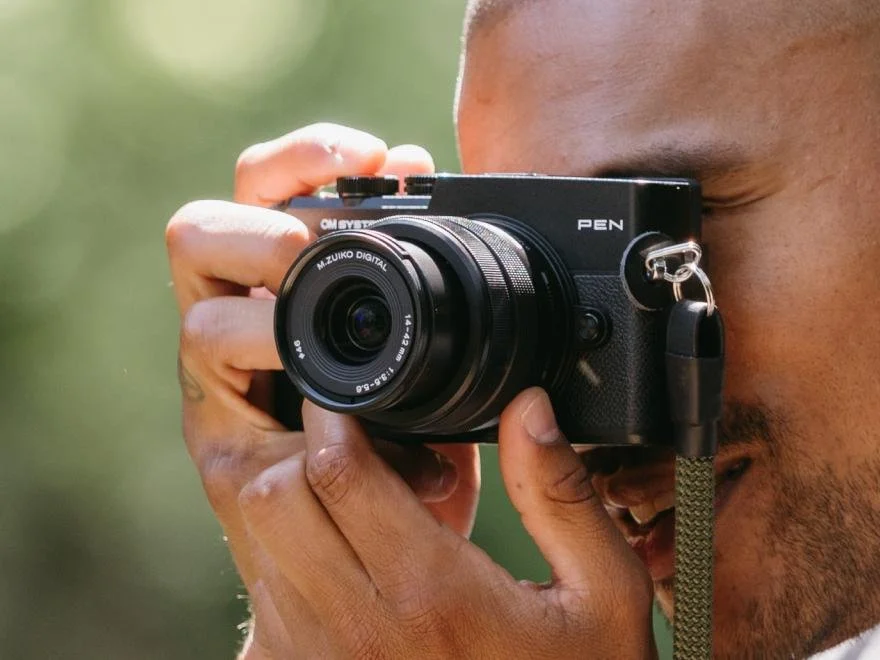
Image credit: Image courtesy of OM SYSTEM.
The viewfinder is particularly important. Several compact cameras depend entirely on a rear screen. That keeps the body small, but it can make composition difficult in bright daylight and encourages the same arms-out shooting position used with a phone. Bringing a camera to the eye changes the experience. The surrounding world becomes quieter, the frame becomes clearer and small relationships near the edges are easier to notice. It doesn’t make the photograph better automatically. It makes concentrated looking easier. The PEN combines that traditional way of working with controls designed around finished images rather than technical purity. A Profile Control switch gives direct access to four colour profiles and four monochrome profiles. These can be used as supplied or customised, and OM System says photographers can share their recipes through OM Workspace or the updated OI.Share app. That feature arrives while interest in film simulations and downloadable colour recipes remains remarkably strong. Some photographers dismiss these tools as filters. Others enjoy producing a photograph that already looks close to finished when it leaves the camera. I think the second response deserves more consideration.
Editing is an important part of photography, but it doesn’t need to become an obligation attached to every frame. A photographer might reasonably want to choose a colour response, contrast curve or monochrome treatment while looking at the scene, then allow that decision to become part of the capture process. That resembles choosing a film stock before making photographs. The result can still be revised from a raw file when necessary. The creative profile simply gives the photographer an immediate interpretation and a more enjoyable JPEG workflow. This could be particularly useful for people who have thousands of unedited photographs waiting on memory cards and hard drives. The most technically flexible file is not always the most useful file. Sometimes a finished photograph shared today has greater personal value than a theoretically perfect raw file that remains untouched for six months. The danger is allowing the recipe to become the subject. A strong colour profile cannot repair weak light, confused framing or an empty moment. If every photograph is being made because a particular film-like appearance is fashionable, the style can become a disguise rather than a decision. The profile should help express what the photographer noticed. It shouldn’t be expected to provide the reason for pressing the shutter.
OM System has also placed a dedicated computational photography button on the PEN. The camera includes High Res Shot, Live ND, Live Composite, multiple exposure, focus stacking and HDR functions. Several of these techniques would traditionally require filters, careful exposure calculations or later processing on a computer. Live ND can simulate the effect of reducing incoming light, making it easier to introduce movement into water, clouds or people without carrying a physical neutral-density filter. Live Composite builds an exposure by adding new bright information as it appears, which is useful for light trails, fireworks and similar subjects. Focus stacking combines photographs focused at different distances to increase sharpness through a close subject. High Res Shot uses multiple sensor-shifted exposures to create a file with additional detail.
These features don’t remove photographic judgement. A moving subject can still cause problems in a multi-frame high-resolution image. Live ND doesn’t behave identically to placing glass in front of the lens. Focus stacking still requires attention to subject movement, camera position and the amount of depth needed. What the features remove is some of the friction. A beginner can explore an effect while seeing what the camera is doing instead of treating advanced techniques as something reserved for specialists. That makes the camera educational without forcing it to feel like a classroom.
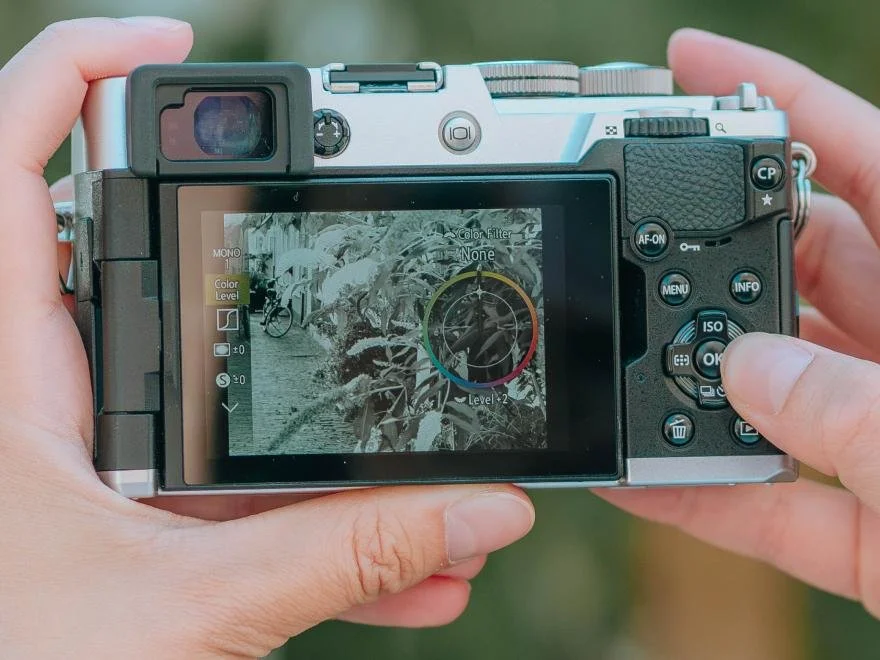
Image credit: Image courtesy of OM SYSTEM.
The PEN also includes AI-assisted subject detection for people and pets. That choice says something about its intended audience. This is not primarily a camera built around photographing racing cars or distant birds, although phase-detection autofocus should make it more capable than older PEN bodies. It is meant for people, pets, travel, neighbourhoods and the fragments of ordinary life that disappear quickly. A reliable autofocus system matters here because ordinary moments rarely repeat themselves for a technical correction. The articulating screen supports photographs made from waist height, overhead or close to the ground. Vertical-video support and built-in OM Cinema profiles recognise that many owners will create photographs and social video with the same camera. Purists may dislike that mixture. I don’t see a reason the camera must choose between serious still photography and convenient video. An everyday camera should adapt to everyday uses.
There are compromises. The 20.4-megapixel resolution will appear conservative beside 40-megapixel APS-C bodies and high-resolution full-frame cameras. The IPX1 rating offers some reassurance around light rain but should not be confused with the more substantial IP53 protection available on cameras such as the OM-5 Mark II and OM-3. The body-only price also places the PEN well above the cheapest beginner cameras. Once a lens is included, buyers will need to decide whether its design, stabilisation and creative features justify the cost. That comparison shouldn’t be made using the body alone. One of Micro Four Thirds’ enduring strengths is its selection of small lenses. A compact 17mm or 25mm prime preserves the reason for choosing this camera. Attaching a large zoom may provide more versatility while gradually rebuilding the bulky kit the PEN was meant to avoid. The complete camera should be judged as something carried, not merely something inspected online. There is also the unavoidable question of nostalgia. The PEN name reaches back to Olympus half-frame film cameras introduced in 1959 and later to the early digital Micro Four Thirds era. The new model clearly draws on that history. Nostalgia is part of the appeal, but that doesn’t make the appeal false.
Cameras are physical creative tools. Their shape, controls and appearance influence whether we want to pick them up. A technically excellent camera that feels like work may be used less than a modest camera that makes photography feel inviting. Enjoyment is difficult to place on a specification sheet, but it affects the number of photographs someone makes. The new PEN will not replace a professional sports body, a high-resolution landscape camera or a full-frame portrait system. It doesn’t need to. Its more interesting competition may be the decision to carry no camera at all. If the viewfinder, compact lenses and creative controls encourage someone to leave the phone in a pocket and pay closer attention to the world, the PEN has achieved something worthwhile. If you want practical help choosing and learning a camera that fits the subjects you genuinely photograph, you can explore my private photography lessons in Brisbane. The best camera isn’t automatically the one with the largest sensor or longest feature list. It is the one whose compromises make sense for you. The PEN arrives at a moment when photographers are rediscovering compact cameras, physical controls and images that don’t require hours of editing. That doesn’t look like resistance to technology. It looks like a desire for technology that gets out of the way. The most important feature of the new PEN may not be its phase-detection autofocus, computational button or creative profiles. It may be the possibility that someone sees it sitting by the door and decides to take it along.
A camera becomes part of everyday life one ordinary photograph at a time.