Sony’s New Fisheye Asks When Photography Stopped Being Weird
Photography has become very good at correcting itself.
Cameras level horizons, lenses pass correction profiles to editing software and a single click can make curved lines stand upright. We remove flare, straighten buildings and tidy the edges until the photograph looks as though the lens was never involved.
Then Sony releases a lens whose entire purpose is to bend the world.
The FE 8–14mm F3.5 Fisheye G is Sony’s first E-mount fisheye zoom. At 8mm it produces a circular image inside the rectangular frame. At 14mm the image fills the frame diagonally, with the familiar fisheye curve pushing straight lines away from the centre. Throughout that range, Sony specifies a 180-degree angle of view.
That is the headline, but Sony wants photographers to notice that this is not merely a novelty optic. The company is emphasising G Lens resolution, controlled chromatic aberration, a constant f/3.5 aperture, quiet autofocus, reduced focus breathing and internal operation suited to stills, video and VR. It weighs 314 grams, focuses as close as 15 centimetres and reaches 0.22x maximum magnification. Sony also highlights dust and moisture resistance, a fluorine-coated front element, a physical aperture ring, a focus-hold button and a zoom lock. The confirmed details are on Sony’s official FE 8–14mm product page.
Those points matter. A strange lens is much more useful when it behaves like a proper photographic tool.
The more interesting question is what I would do with it.
I would not try to disguise the distortion. If I wanted straight lines and a conventional ultra-wide view, I would use a rectilinear lens. A fisheye becomes interesting when the curve participates in the photograph rather than appearing as a fault to be corrected later.
At 14mm, I would begin with subjects that already contain circular movement: the bowl of a stadium, a spiral staircase, a domed ceiling, the inside of a tunnel or clouds rotating around a strong centre. Placing the horizon through the middle can keep it comparatively restrained. Moving it towards the top or bottom makes the curve obvious. Neither choice is automatically right; the important thing is to see the distortion before pressing the shutter and decide what it contributes.
Sony’s own gallery makes that intention clear. Its low-angle photograph of a long jumper uses the stadium to form a curved enclosure around the athlete. The extended leg becomes enormous because it is close to the lens, while the background seems to fall away. This is not a neutral record of the event. It is an interpretation of speed, reach and physical force.
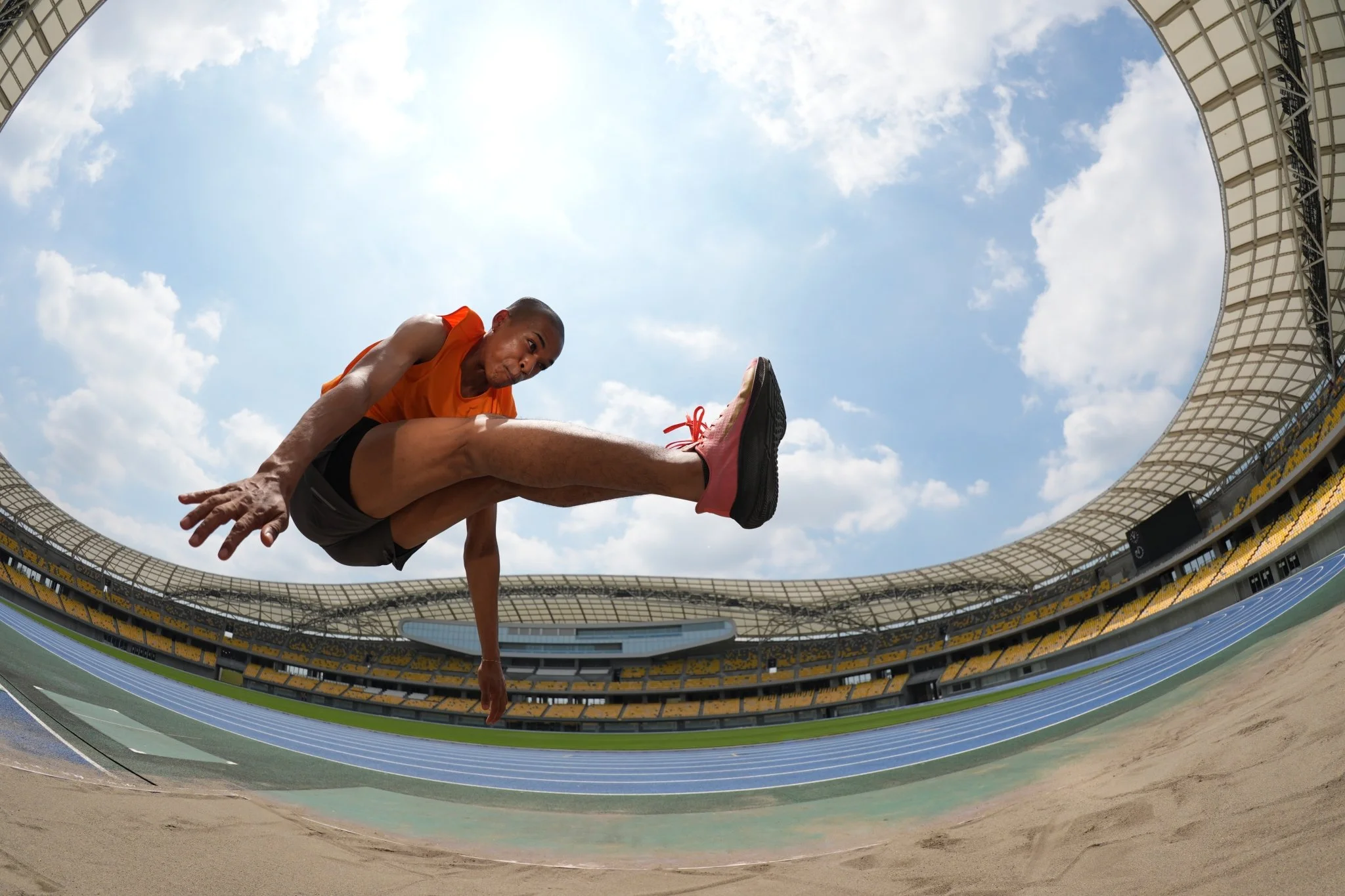
Sony’s 14mm sample shows how a close subject can dominate while the stadium wraps around the frame. Image: Sony Corporation.
That close perspective is where I think the lens could be most playful. A minimum focusing distance of 15 centimetres means the camera can be placed near a flower, wheel, instrument, hand or textured foreground while still describing a huge amount of the surroundings. The subject becomes exaggerated and the setting remains unmistakable.
It would suit skateboarding, cycling, dance and live performance, provided the photographer can work safely and avoid interfering with the action. It could make an environmental portrait feel energetic, although I would be careful with faces. A face near the edge of a fisheye frame stretches quickly. That may be funny or confrontational when intended, but it is rarely flattering by accident.
The 8mm end changes the problem completely. The circular image leaves black around the photographed world and turns composition into a graphic exercise. The frame no longer has ordinary corners, so there is nowhere for visual clutter to hide. The centre, the circumference and the balance of the circle become more important than the rule of thirds.
I would look straight up beneath trees, architecture or a group of people leaning over the camera. I would use openings such as caves, arches and doorways to create a second frame around the circle. Reflections in polished objects or shallow water could produce images that feel less like a corrected view of reality and more like a contained little world.
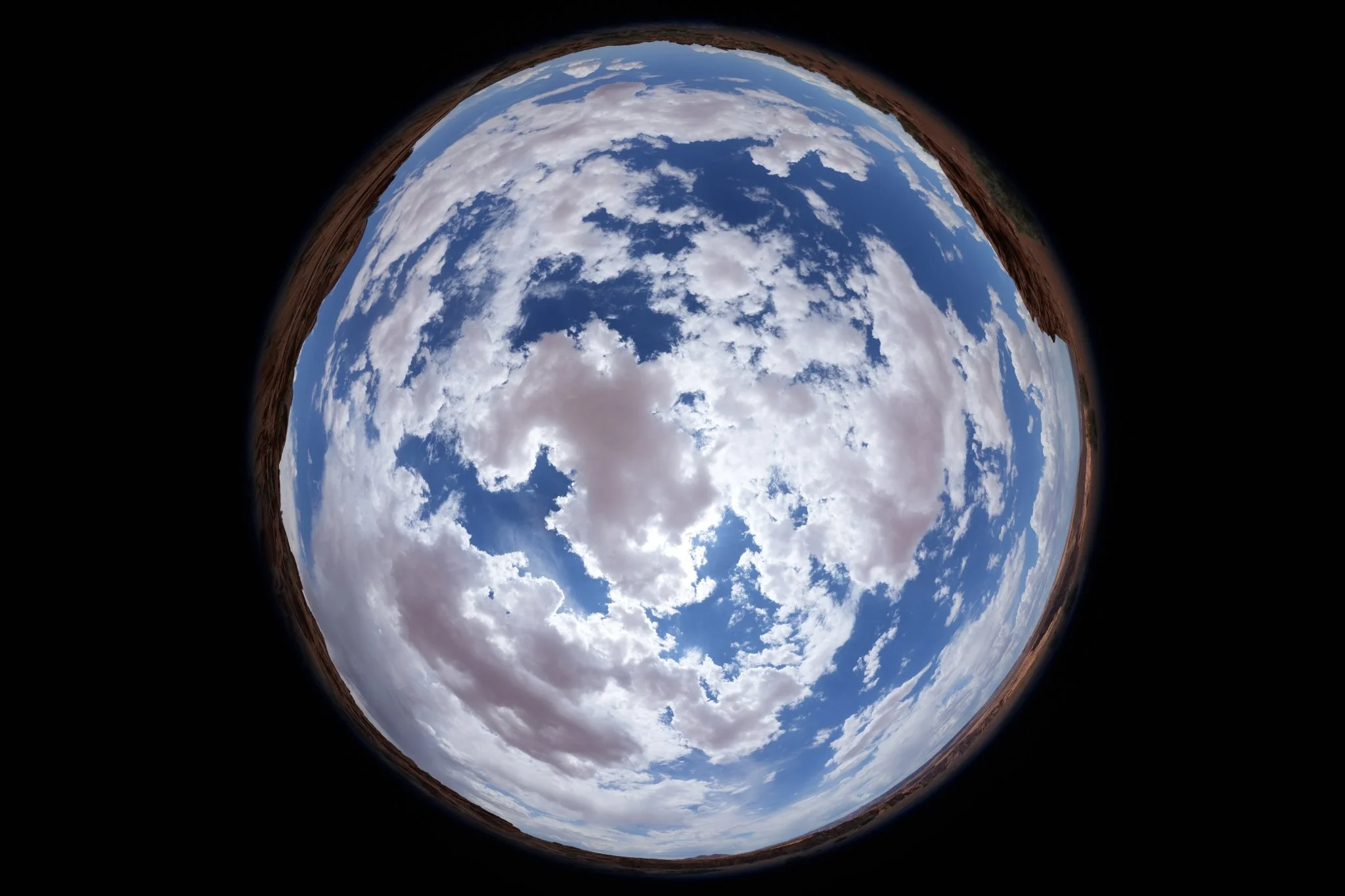
At 8mm, Sony’s sample turns the entire scene into a circular composition rather than a conventionally framed wide photograph. Image: Sony Corporation.
This is also where I would take the lens into astrophotography.
Sony does not currently include a night-sky photograph in its official sample gallery, so the astrophotography case is my intended use rather than a claim based on Sony’s examples. The appeal is the coverage. At 8mm, a circular fisheye can record an enormous dome of sky in one frame. That opens possibilities for a Milky Way arch, long star trails surrounding a celestial pole, meteor showers spread across a broad area, aurora patterns and time-lapse sequences where events may occur far from the direction the camera first appears to face.
At 14mm, I would use the frame-filling view when I wanted the sky to feel immersive without the black surround of a circular image. A distinctive tree, rock formation, hut or observatory could anchor the centre or lower part of the frame while the Milky Way curves around it.
F/3.5 is not especially fast beside an f/1.8 or f/2 astrophotography prime. That is a genuine trade-off, not something the unusual focal length makes disappear. I would expect to use a higher ISO or combine several exposures when the subject and workflow allowed it. The extremely wide view can tolerate a longer shutter time before star movement becomes obvious at ordinary viewing sizes, but the correct time still depends on focal length, sensor resolution, where the stars sit in the frame and how closely the result will be inspected.
On a dark-sky outing, I would begin in RAW at f/3.5, focus manually on a bright star using magnified live view, then make short test exposures rather than trusting a formula. Somewhere around 10 to 20 seconds and ISO 1600 to 6400 would be a practical starting range on many full-frame cameras, not a guaranteed setting. I would inspect the stars near the edge, the brightness of the sky and the sharpness of the foreground before deciding what to change.
The biggest practical danger may be including things I never meant to photograph. At 180 degrees, tripod legs, shoes, torchlight and the photographer’s own shadow can enter the frame. The front element is also exposed, so placement and handling in darkness require care. This lens rewards a slow check of every edge, even when the point of the photograph is visual chaos.
Autofocus is useful for action, but for stars I would value repeatable manual focus more. Sony’s Linear Response manual focus and physical controls should help, although I would still tape or carefully check the ring during a long sequence. The internal zoom is also welcome because the lens does not change its balance as the framing moves from circular to diagonal.
Would I recommend this as a first ultra-wide lens? No. Its look is too specific, and the effect can become repetitive when every subject is forced through it. A beginner can explore fisheye composition with a cheaper manual lens or a rental before committing to a premium autofocus zoom.
But I am pleased this lens exists.
Photography equipment is often marketed as a path towards greater accuracy. More resolution, cleaner corners, straighter lines and more reliable correction all have real value. They can also tempt us into making every photograph technically tidy and visually familiar.
The fisheye refuses to be invisible. It asks the photographer to commit to a point of view.
If you want practical help understanding perspective and choosing lenses for the photographs you actually want to make, you can explore my private photography lessons in Brisbane. We can work with ordinary lenses or unusual ones, but the aim is the same: make the optical choice deliberate.
Sony’s 8–14mm may be a specialised and expensive answer to a question many photographers have never asked. That is part of its appeal.
When photography starts feeling too correct, a lens that bends the horizon might be exactly the wrong tool in the right hands.