The Next Camera Feature Won’t Improve Your Photos—It Will Prove They’re Real
We’ve spent decades asking whether the next camera can make a better photograph. The next important question may be whether it can prove the photograph began in a camera at all. That sounds like a problem for newsrooms, courts and technology companies. It is, for now. But it is also a photography problem, because believable synthetic images no longer need to look obviously artificial. A photograph can be copied, altered, stripped of context and reposted long before anyone finds the original.
Canon is trying to build part of the answer into the photographic workflow. Its Authenticity Imaging System uses the C2PA standard to attach a verifiable history to an image. Canon says supported EOS R1 and EOS R5 Mark II cameras can record provenance at the moment of capture, after which approved edits and handling can be added to that history. Canon introduced the system for news organisations in Europe, the Middle East and Africa in May 2026, after working with Reuters on technical testing. It then demonstrated the technology during Visa pour l’Image’s professional week in Perpignan, held from 31 August to 5 September 2026. The details are in Canon’s system announcement and its Visa pour l’Image programme.
This is not a new autofocus mode or another claim about dynamic range. It won’t make a face sharper, rescue poor light or improve a composition. It may make the history of a photograph easier to inspect. The basic idea is less complicated than the language surrounding it. When the shutter is pressed, the camera can create a signed record connecting the file to its source. Later stages in a compatible workflow can record what happened next. A crop, tonal adjustment or export can become part of the chain instead of leaving viewers to guess whether the file was changed and how.
The Coalition for Content Provenance and Authenticity describes Content Credentials as something like a nutrition label for digital media. That is a useful comparison. The label does not tell us whether we will like the product. It gives us information with which to judge it. The C2PA overview explains the standard, while its official explainer is careful about the limits. Those limits matter. Authenticated provenance is not an AI detector. It does not examine pixels and announce that an image is real or fake. It is not a watermark placed across the photograph, and it is not digital rights management that prevents someone from copying the file. C2PA describes the record as open, tamper-evident and available for a viewer to inspect.
Most importantly, provenance is not proof that everything represented by the photograph is true. A camera can record that a file was captured by a particular device at a particular point in a workflow. It cannot know whether the scene was staged before the shutter was pressed. It cannot decide whether a caption is misleading. It cannot tell us that a photographer framed just outside an important detail or waited until an event looked more dramatic than it really was. Canon makes this distinction plainly in its own Authenticity Imaging System explanation: the technology can flag changes to pixels and document legitimate edits, but it cannot detect staging before capture. That does not make the system weak. It makes it specific.
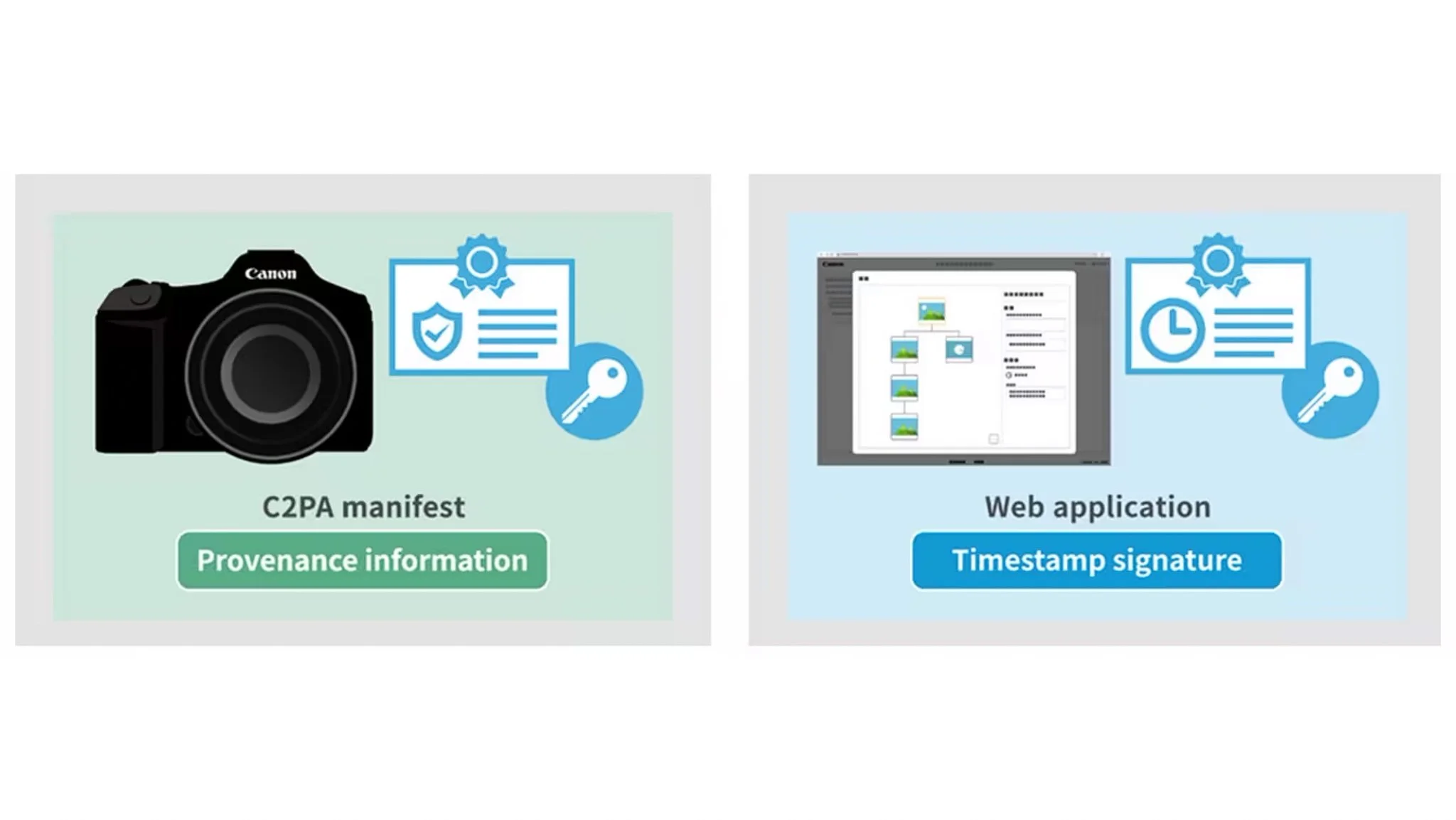
Photo Credit: Canon
For years, much of the response to manipulated media has concentrated on detection. Software looks for strange edges, inconsistent lighting, repeated texture or traces left by a particular generator. Detection can help, but it becomes an arms race. As generation improves, yesterday’s obvious error becomes tomorrow’s corrected feature. Provenance starts at the other end. Instead of trying to prove that every suspicious image is false, it allows a creator to preserve evidence about where a file began and what happened to it. I find that a more useful direction, provided we don’t turn the absence of credentials into automatic guilt. Billions of honest photographs already exist without C2PA records. Many cameras and editing programs do not support the standard. Social platforms may remove metadata or fail to display credentials clearly. A file without a verifiable history is simply unverified; it is not automatically fraudulent.
There is another important distinction for photographers: editing is not dishonesty. A crop, exposure correction or careful colour adjustment can be a normal part of photography. A provenance system should document that work rather than pretend a pure photograph emerged fully finished from the camera. The useful question is not whether an image was edited. It is whether the available history helps us understand the nature of those edits. That could eventually matter beyond photojournalism. Competitions may want clearer records for categories that restrict digital manipulation. Researchers, insurers, property professionals and documentary photographers may need to demonstrate where an image came from. Families building long-term archives may value files whose origin survives after names and memories have faded. The immediate system, however, should be kept in perspective. Canon’s rollout is aimed at professional organisations and presently names the EOS R1 and EOS R5 Mark II as supported cameras. This is not a reason for a beginner to replace a perfectly useful camera. It is an early example of where camera design and publishing may be heading.
Ordinary photographers can still learn from it now. Keeping original RAW files, maintaining sensible backups and avoiding a chaotic trail of unnamed exports already makes authorship easier to establish. Saving an edited master before producing smaller social-media copies preserves more of the working history. Accurate captions and dates matter too. None of these habits provides the cryptographic assurance promised by C2PA, but they create a more credible archive and a workflow that will be easier to adapt. Privacy will need equal attention. A trustworthy system cannot require every photographer to publish an exact location, identity and equipment serial number with every picture. There are obvious reasons a photojournalist, wildlife photographer or person documenting a sensitive event might withhold some details. Credentials must give creators meaningful control over what is disclosed while still allowing important claims to be verified.
There is also the question of access. If authenticated capture remains tied to expensive professional bodies and enterprise subscriptions, it will protect only a small portion of the images people see. Trust works better when the standard is widely available across cameras, phones, software and publishing platforms. I don’t think every holiday photograph needs a certificate. I do think viewers will increasingly ask for better evidence when an image carries public consequences. A photograph used to report a war, document an environmental event or support a serious accusation should face a different standard from a family picture shared among friends. The danger is treating the credential as a substitute for judgement. A verified capture can still be badly framed, selectively captioned or used in the wrong context. A trustworthy photographer can still make a mistake. Technology can strengthen the evidence around an image, but it cannot take responsibility for the story told with it.
That is why this development belongs in photography education, not only cybersecurity discussions. Photographers need to understand that trust is built through capture, editing, captioning and publication. Technique decides what enters the frame. Ethics determines how the frame is presented. Provenance can record parts of that process, but it cannot make those decisions for us. If you want to build a clearer photographic workflow while gaining confidence with the camera you already own, you can explore my private photography lessons in Brisbane. Good files begin with deliberate choices long before any certificate is attached.
Canon’s system will not settle every argument about whether a photograph is real. No single feature can. What it offers is more modest and perhaps more valuable: a way to show where an image began, which steps followed and whether that recorded history remains intact. The next generation of cameras will keep promising more speed, resolution and automation. Yet the feature that matters most may be the one that leaves the photograph looking exactly the same while giving us a better reason to trust its journey.